
AI, Budget, or Advisory? How to Choose the Right Financial Support
If you own a business, you've probably seen the ads: "Your books, done by AI." "Bookkeeping for a fraction of the cost." "Never think about your finances again." Some of them are genuinely good options. Some of them are solving a different problem than the one you actually have.
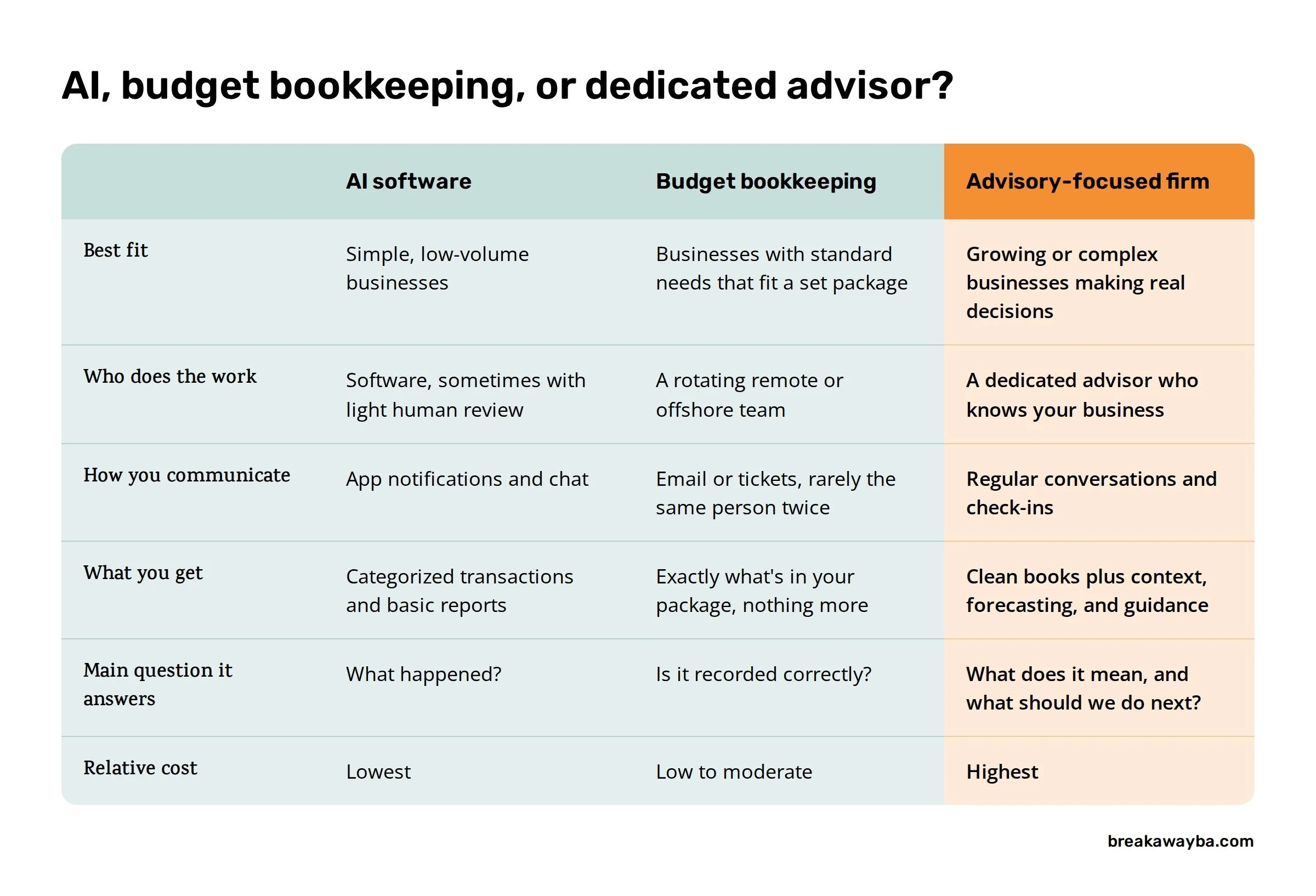
AI bookkeeping, budget bookkeeping, and advisory-focused firms aren't really competing for the same job. Each one is built to do something different, and the right fit depends on what you need your numbers to do for you.
That distinction matters whether you're a business owner weighing your options or a banker, wealth manager, or attorney whose clients keep asking, "Who should I use for my books?" The wrong fit rarely shows up right away. It shows up later, as a cleanup project at tax time or a big decision made without good information.
None of this is a knock on AI or lower-cost services. Breakaway advisors use AI tools every day, and plenty of great businesses run successfully on budget bookkeeping. It's about matching the tool to the job.
AI bookkeeping: fast, cheap, and as good as what you feed it
AI bookkeeping uses software to pull in transactions from your bank and credit cards, categorize them automatically, and produce basic reports. Some services are fully automated, others add a light layer of human review.
What it looks like: Maya runs a solo design studio. She has one business checking account, one credit card, and about 40 transactions a month, mostly software subscriptions and client payments. An AI tool categorizes everything, flags the occasional oddball charge for her to confirm, and hands her a tidy P&L each month. It works beautifully for her.
What it's good for:
Simple businesses with low transaction volume and few accounts
Owners who want to stop doing data entry themselves
Keeping records current and organized between tax seasons
Speed: books can be updated daily rather than weeks after month-end
Where it falls short: AI is great at patterns and not so great at judgment. It can't advise you on the potential pitfalls of paying a personal an expense out of your business account, know that your inventory should be categorized differently this month, or understand why a cluster of refunds is a warning sign. It also won't call you to ask. If something gets set up wrong at the start, AI will repeat that mistake confidently, every month, until someone catches it. Plus, owners often use this option when they don't have accounting expertise themselves, meaning they might not know what to look for or how to spot errors or missed opportunities. So, this can be a great option for certain businesses, but it's always worth having an experienced advisor review the output from time to time.
Budget bookkeeping: the basics, by the package
Budget bookkeeping services offer a set menu: a few preset packages, each with a defined list of what's included, at a low monthly price. Some are offshore firms; others are remote providers built for volume. Either way, the model is the same. You get what's in your package, and that's it.
What it looks like: A landscaping company with two crews signs up for a mid-tier package covering monthly reconciliations, bill coding, and a standard set of financial statements. The books get done each month. But when the owner asks whether he can afford a third crew, the answer is a link to an upgrade tier or a note that forecasting isn't included. And the person replying is rarely the one who answered last time.
What it's good for:
Businesses with standard, predictable needs that fit neatly into a package
Getting human-reviewed, reconciled books at a lower, fixed cost
Owners who already know what they need and don't need much guidance
Keeping the basics covered while a business is still small
Where it falls short: The package is usually focused on task completion rather than forward-thinking advice. And because you don't often speak to the same person twice, it’s hard to get honest feedback about what you might be missing, and what additional services you could use. That also means re-explaining the quirks of your business more often than you'd like, and no one ever building a real picture of how it works.
Advisory-focused firms: your books, plus someone who reads them with you
An advisory-focused firm, like Breakaway, keeps your books clean and helps you use them. You work with a dedicated advisor (a bookkeeper, controller, or fractional CFO, depending on what you need–or a team approach) who knows your business and talks with you regularly about what the numbers are saying.
What it looks like: A family-owned construction firm is opening a third location. Their advisor reviews monthly results with the owners, notices that materials costs at one location have crept up three months in a row, builds a cash flow forecast for the new opening, and helps them figure out whether they can afford a general manager before or after launch. The books still get done. The difference is that someone is connecting them to real decisions.
What it's good for:
Growing businesses facing decisions about hiring, pricing, expansion, or financing
More complex situations: multiple entities, inventory, payroll, mergers & acquisitions
Owners who want a consistent person who knows their business, not a rotating queue
Turning clean books into useful books: reports with context, trends, and cash flow visibility
Where it falls short: It's a bigger investment than the other two options, and it isn't always necessary. A brand-new business with a handful of transactions a month likely doesn't need a fractional CFO yet.
A quick word on tax-focused vs. advisory-focused firms
Even among personalized, human-led firms, there's an important difference. Many bookkeeping firms are tax-focused: their main goal is getting your books ready for your CPA at year-end. That's valuable, but it means the books are built to look backward and satisfy compliance.
An advisory-focused firm builds your books to look forward. The same transactions get organized in a way that helps you answer questions like "Can we afford this hire?" or "Which clients are actually profitable?" Both approaches can produce accurate books. Only one is designed to help you run the business day to day.
side-by-side
How to tell if you need more support
Plenty of businesses start with AI or budget bookkeeping and that's a perfectly reasonable choice. The question is whether it still fits. Here are some signs you might be ready for more:
Your books are "done," but you still feel like you're guessing. You get reports each month, but you're not sure what they're telling you or what to do with them.
You're facing a big decision. Hiring, raising prices, opening a location, taking on a loan, or bringing in an investor are all moments where clean records aren't enough on their own.
Cash surprises you. The P&L says you're profitable, but payroll weeks still feel tight.
Your business got more complicated. You've added inventory, employees, a second entity, multiple revenue streams, or a lender who wants regular financials.
You keep re-explaining your business. Every few months there's a new person on your account who doesn't know your history.
Your CPA keeps finding problems at tax time. Cleanup projects at year-end usually mean something isn't being caught during the year.
You're spending your evenings answering bookkeeping questions. If you're the one doing the thinking, the service may not be saving you as much as you hoped.
If two or three of these sound familiar, it may be time for a conversation. Not necessarily a big change, just a check on whether your current setup still matches where your business is headed.
For bankers, wealth managers, attorneys, and other trusted advisors
Your clients ask you who they should use for their books, and you want to point them somewhere good. Here's a simple way to think about it: if the client mostly needs tidy records, a lower-cost or automated service may be a fine fit. If you hear any of the following, that's usually a sign they need an advisory-focused firm:
"I don't really understand my financials."
"We're growing fast and I'm not sure we can afford it."
"My bookkeeper does the books, but nobody tells me what they mean."
"The bank asked for financials and I'm scrambling."
"My controller is leaving and I don't know who will cover it."
"We're thinking about selling the business in the next few years."
Those are the moments when a client needs a partner, not just a processor. A good advisor makes your work easier too: cleaner financials for loan packages, clearer conversations about cash and planning, and a client who feels more confident about their business.
The bottom line
There's no single right answer here, only the right fit for where your business is today. AI tools are great at speed. Budget services are great at covering the basics at a predictable price. Advisory-focused firms are great at helping you understand what it all means and what to do about it.
If your books are getting done but you're still not sure what they're telling you, that's a very solvable problem. We'd be happy to talk it through, even if the answer is that what you have is working just fine. Reach out to a Breakaway advisor to start the conversation.
Want to go deeper? Check out The Difference Between Clean Books and Useful Books and How an Experienced Advisor Can Transform Your Business.